

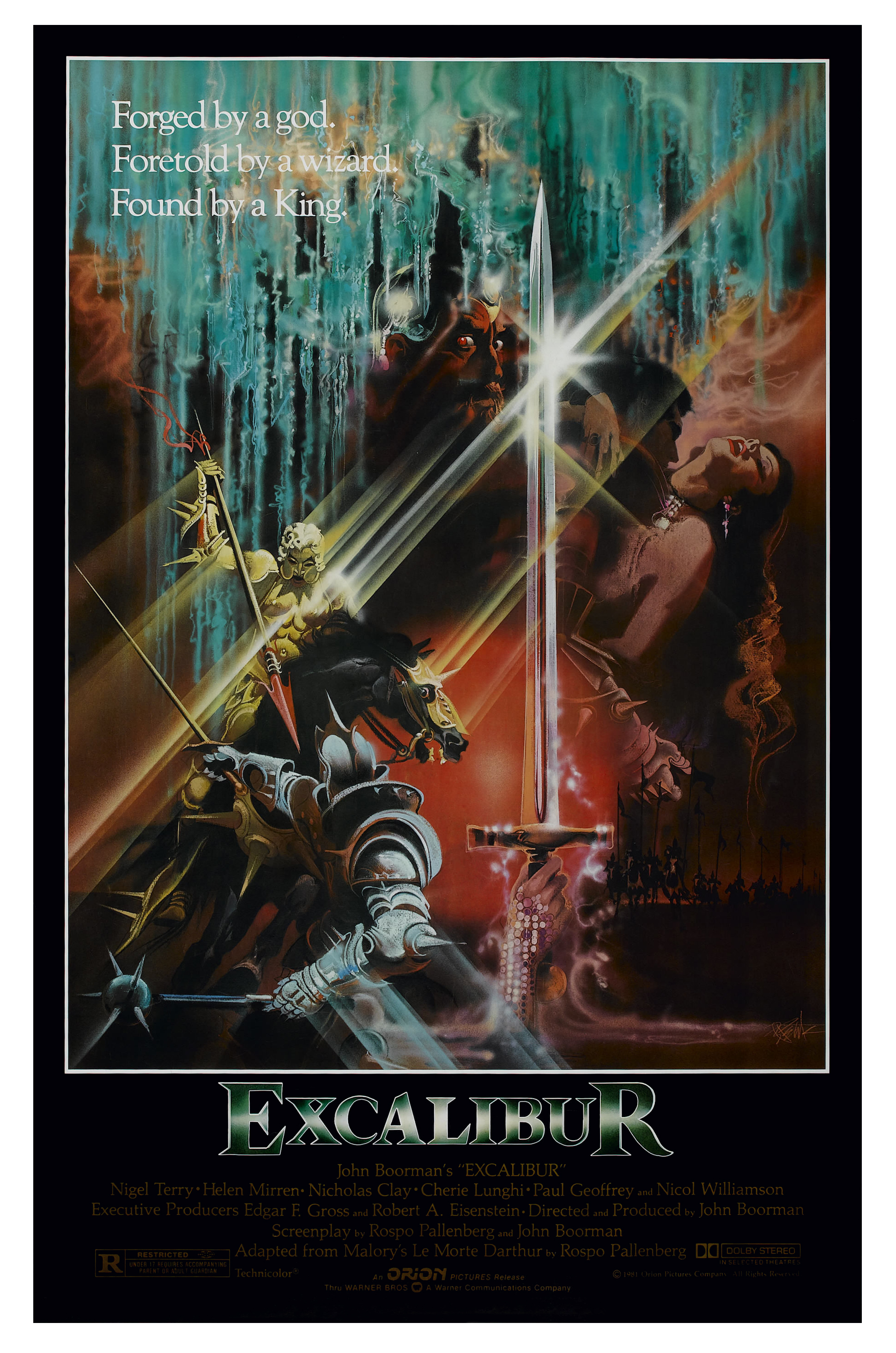
Synopsis – John Boorman’s Excalibur brings the legend of King Arthur to vivid life, charting his rise and fall through the mystical power of the legendary sword. A tale of knights, magic, and betrayal unfolds in a dreamlike, visually stunning, and often brutal fashion.
Director – John Boorman
Cast – Nigel Terry, Helen Mirren, Nicol Williamson
Released – 1981
Few films capture the sheer madness, majesty, and mythology of Arthurian legend quite like John Boorman’s Excalibur. A fever dream of mist-shrouded forests, clanking armour, and grandiose declarations of destiny, this 1981 epic remains a towering achievement in British fantasy cinema—messy, magnificent, and utterly mesmerising.

At its heart, this is the classic tale of King Arthur, from his tumultuous conception (in a scene of dark sorcery and disturbing lust) to his rise as a noble ruler and his tragic downfall. Boorman’s adaptation of Le Morte d’Arthur is both reverent and wildly unrestrained, embracing the mysticism and brutality of the original legends with a Shakespearean flair. If you’re looking for a sanitised, family-friendly Arthur, this isn’t it—this is a film dripping with blood, sweat, and existential dread.
Nigel Terry delivers a solid, if sometimes theatrical, performance as Arthur, charting his journey from unsure boy-king to weary monarch. Helen Mirren shines as the vengeful Morgana, exuding menace with every venom-laced whisper, while Nicholas Clay’s Lancelot is every inch the doomed romantic warrior. Yet, the film’s true star is Nicol Williamson’s Merlin. Bizarre, whimsical, and occasionally outright mad, his performance is a masterclass in scene-stealing eccentricity, oscillating between wise sage and sardonic trickster. His chemistry with Mirren—both on-screen and in real life (they famously loathed each other)—adds a fascinating layer of tension to their magical battle of wills.

Visually, Excalibur is a feast of dreamlike imagery. The misty Irish landscapes, bathed in eerie green light, lend the film an ethereal quality, while Alex Thomson’s cinematography turns shining armour into something almost otherworldly. Boorman revels in the grotesque and the grand, juxtaposing brutal battles with moments of eerie serenity. The violence is raw and unrelenting, each sword clash carrying real weight, but so too is the film’s commitment to mythic grandeur.
If Excalibur has a flaw, it’s that it sometimes teeters on the edge of incoherence. Boorman’s storytelling is impressionistic rather than precise, prioritising mood and imagery over clarity. Some performances verge on hammy, and the dialogue—delivered with the utmost sincerity—might sound laughable to modern ears. But these eccentricities are precisely what make the film so compelling. It’s a film that feels like a legend, unfolding as a series of heightened, symbolic moments rather than a conventional narrative.

Backed by a thunderous Wagnerian score (because what’s an Arthurian epic without Carmina Burana blaring at full volume?), Excalibur is a singular vision—flawed, glorious, and unlike anything else in the genre. Whether you view it as an unhinged fever dream or a misunderstood masterpiece, one thing is certain: it’s a film that lingers in the mind long after the last sword is raised.
 Roses Have Thoughts
Leave a comment