

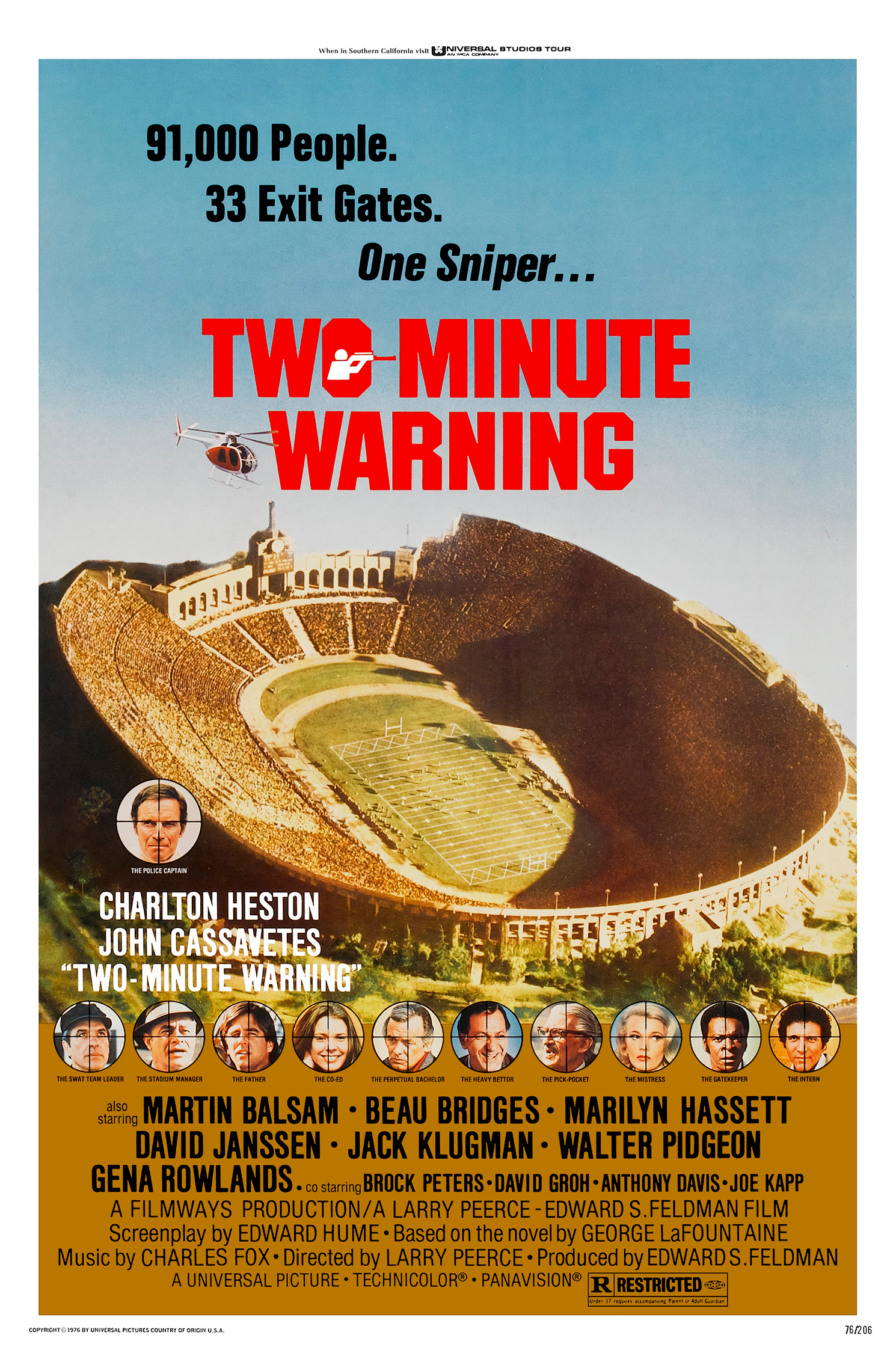
Synopsis- During a packed American football game at the Los Angeles Memorial Coliseum, an unseen sniper takes position high above the crowd. As police scramble to locate him, tensions rise, culminating in a suspense-filled finale that questions crowd psychology and law enforcement response.
Director- Larry Peerce
Cast- Charlton Heston, John Cassavetes, Beau Bridges
Released- 1976
There’s something almost nostalgically brutal about Two-Minute Warning, a suspense thriller that barrels headlong into its own moral grey zones with the swagger of a ‘70s American procedural and the uncomfortable prescience of a newsreel. Directed by Larry Peerce, this film is an underrated example of the era’s fondness for ensemble tension and disaster-movie pacing, a kind of pre-Network cautionary tale with a rifle.

The set-up is pure cat-and-mouse: an anonymous sniper, played chillingly without dialogue or motive by Warren Miller, positions himself in a stadium packed with 91,000 people. Charlton Heston, all jawline and authority, leads the law enforcement effort with suitably gravelly gravitas, while John Cassavetes simmers with world-weary intensity as the SWAT commander who knows just how badly this could all go.
What Two-Minute Warning does exceptionally well is bottle tension. Peerce’s direction is deliberate and voyeuristic, frequently placing the camera in elevated, God-like positions, much like the killer himself. The stadium, a monument to American mass culture, becomes a pressure cooker, the wide shots contrasting claustrophobically with the inner drama unfolding below. Composer Charles Fox scores the dread effectively, with strings that stretch taut over the action like piano wire.

In typical ‘70s style, the plot blooms sideways rather than forward, giving us peeks into the lives of ordinary citizens in the stands: a bickering couple, a priest and his choirboys, a lonely divorcé. These vignettes sometimes veer into soap opera, but they give the carnage that follows a human face. And yes, some of the performances teeter on the melodramatic, but that’s part of the charm. Beau Bridges is especially affecting as a father whose day out with his son descends into terror.
Critically, Two-Minute Warning was divisive on release, and perhaps understandably so. It’s less about explaining the sniper’s motivation (which it doesn’t) and more about exploring the chaos he causes. That ambiguity is both its strength and weakness. In today’s climate, the lack of psychological depth might be seen as a cop-out, but viewed as a grim parable of institutional failure and the fragility of social order, it holds up surprisingly well.

Overall, it’s a grimy, muscular thriller with teeth, if not quite the intellectual bite of Dog Day Afternoon or The Conversation. Still, for a film about an anonymous man with a rifle, Two-Minute Warning says quite a lot, even in its silence.
 Roses Have Thoughts
Leave a comment