

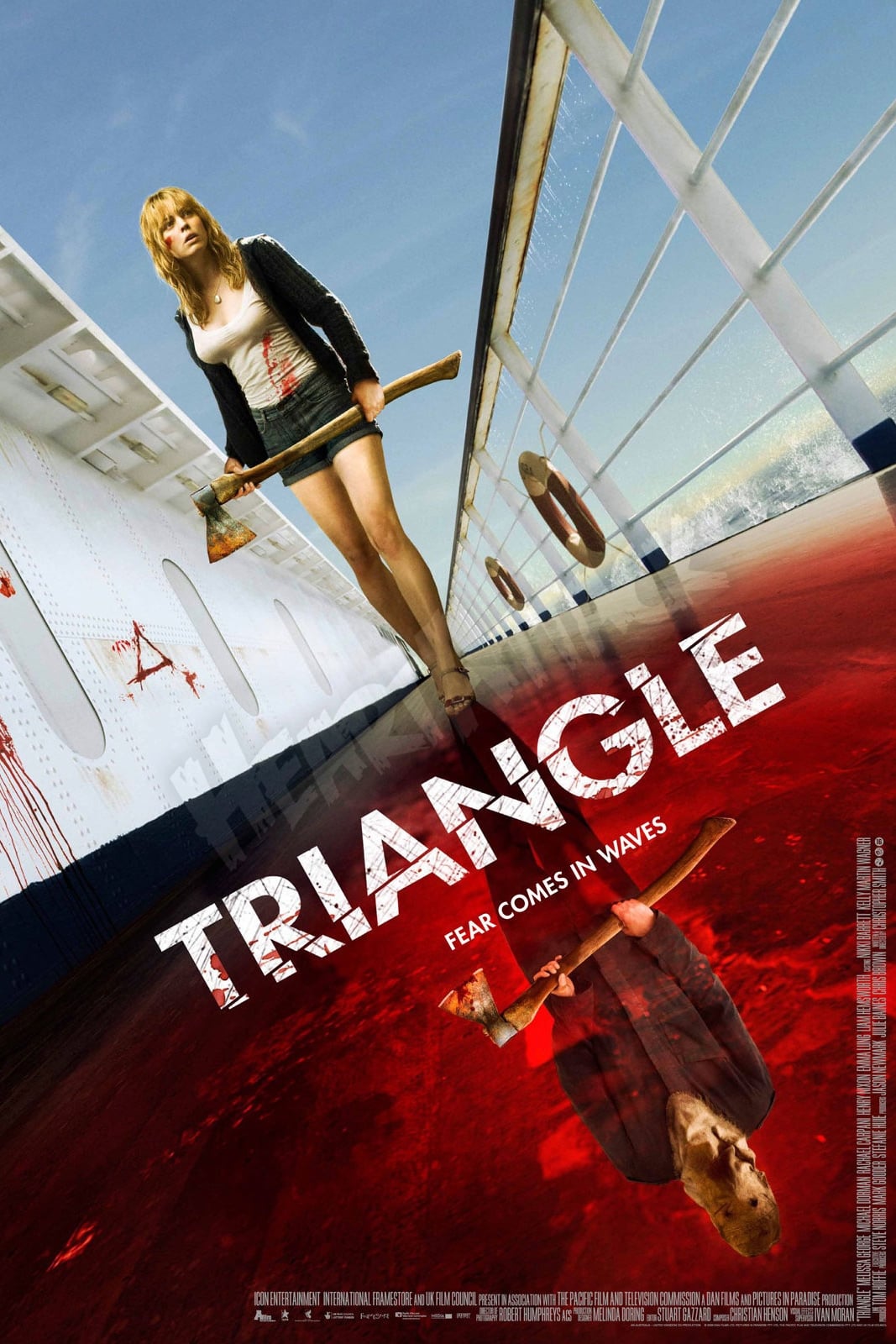
Synopsis- A troubled woman finds herself trapped in a looping nightmare aboard an abandoned ocean liner, where time fractures, identities shift, and a horrific truth claws to the surface.
Director- Christopher Smith
Cast- Melissa George, Liam Hemsworth, Michael Dorman, Rachael Carpani, Henry Nixon, Emma Lung
Genre- Mystery, Thriller, Horror
Released- 2009
Christopher Smith’s Triangle is a bold, unnerving psychological thriller that dances on the edge of horror and existential despair, a complex tale of guilt and repetition that spirals its protagonist, and us, into a sometimes confusing abyss of terrible recognition. Melissa George delivers a career-best performance as Jess, a single mother whose day sail with a group of friends veers into uncanny territory when they’re forced aboard a seemingly deserted ocean liner. What follows is a feverish descent into fractured timelines and moral reckoning, told with a skill that belies the film’s modest budget.
Smith, who has long shown a penchant for genre subversion, just look at his 2006 slasher Severance, which could have just been another Danny Dyer cheese-fest, but ended up being so much more. Here crafts something far more ambitious than a slasher on the high seas. His film draws on the spatial uncanny of The Shining, the looping dread of Don’t Look Now and the mythic structure of Greek tragedy meets Groundhog Day, yet feels distinctly its own unique beast. There’s an almost clinical precision to the way the film’s mysteries unfold: each circuit of events opens like a trapdoor to another layer of meaning, another confrontation Jess cannot escape. The ship itself becomes a metaphorical labyrinth, sterile, echoing, an infinite hall of mirrors in which every reflection threatens violence.

George is essential to keeping the narrative emotionally anchored. Her Jess is flinty, haunted, resourceful, and heartbreakingly human. As the film twists the chronology into Möbius strips, George grounds it with a rawness that makes the story’s final revelations all the more wrenching. Hers is a performance of subtle recalibrations; each repeated sequence becomes an opportunity to shade Jess with new gradations of fear, fury, and dawning comprehension.
The supporting cast, Liam Hemsworth in an early role, Michael Dorman adding notes of worry and suspicion, serve primarily as satellites orbiting Jess’s increasingly disturbed psyche. Yet Smith never treats them as disposable. Even as the film edges toward the fatalistic logic of a loop, he invests each encounter with a sting of emotional consequence, as if daring us to hope for an escape that the narrative itself insists cannot come.

Smith’s direction is lean but expressive. His camera prowls the ship’s cavernous interiors with a slow, deliberate curiosity, inviting us to look again, and then again, as though the truth might lurk in the periphery. The editing is crisp, the score taut and unsettling, and the overall mood one of tightening inevitability. By the time the final act reveals the full tragedy of Jess’s predicament, we understand that the horror is not the loop itself but what created it.
Triangle is not merely a puzzle-box film but an emotional reckoning disguised as one. It lingers like a half-remembered nightmare, disturbing, ingenious, and strangely poignant. Smith pulls off something rare: a horror film that grows sadder the more one understands it.
 Roses Have Thoughts
Leave a comment