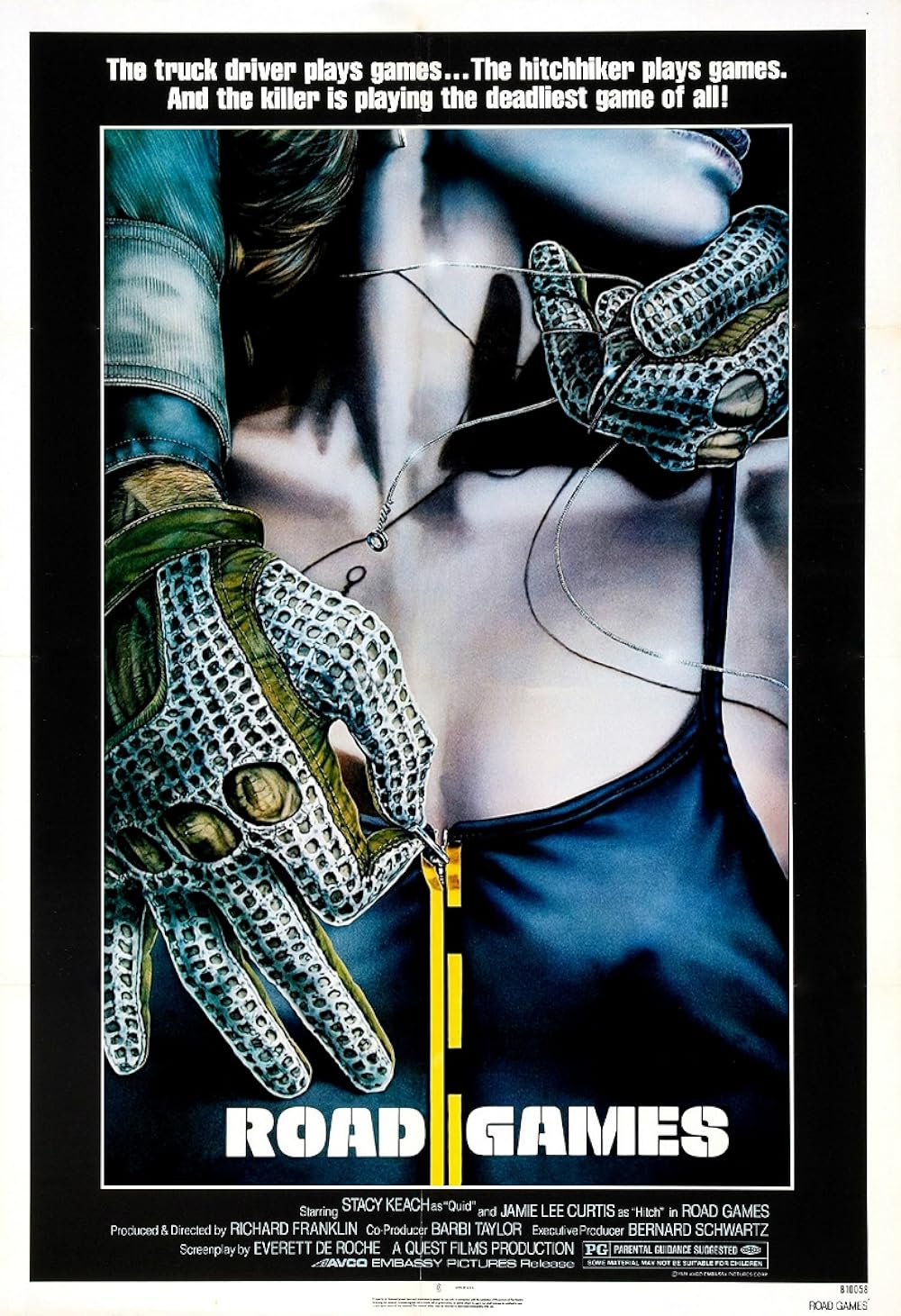
Synopsis: On remote Australian highways, a truck driver suspects a serial killer while hitchhiking, forming uneasy alliances as tension builds across endless, isolating, sun-baked roads.
Director: Richard Franklin
Cast: Stacy Keach, Jamie Lee Curtis, Grant Page
Genre: Thriller, Road Movie, Psychological Thriller, Crime
Released: 1981
Not many thrillers show the strange feeling of space quite like Roadgames, Richard Franklin’s suspenseful and playful film. The wide Australian outback somehow feels closed off and secretive here. Even now, it’s easy to see how the film balances its different sides: the open road movie with the tight psychological drama, the careful with the paranoid.
Stacy Keach plays Pat Quid, a long-haul truck driver whose days are filled with highways, radio, and being alone. Keach’s steady acting brings depth and a careful intelligence to the film. Quid isn’t your usual hero; being alone feels normal to him. He’s watchful, has a dry sense of humour, and becomes more uneasy as he starts to suspect something is wrong.

The story seems simple at first: Quid suspects another traveller might be a serial killer and starts following him along Australia’s endless roads. But Franklin focuses less on solving the mystery and more on the feeling of suspicion. What does it mean to know something when there are hardly any witnesses? How do you act when you can never be sure?
Jamie Lee Curtis plays a clever hitchhiker who becomes Quid’s uneasy partner. She adds a modern sense of wit and independence to the film. Her role changes the mood, keeping the story from feeling too lonely. Their teamwork is cautious rather than trusting, and Franklin keeps their relationship uncertain, suggesting that even having company can feel risky.

Roadgames stands out for its smooth style. The camera moves over windshields, mirrors, and long stretches of road in a way that feels fresh, hinting at Hitchcock but never copying him. The film feels light on the surface, but there’s real tension underneath. Franklin shows that suspense isn’t just about what’s hidden, but also about what we see too much or too unclearly, until things stop making sense.
The film’s humour is also important. Some of the jokes are dry and subtle, which keeps the tension from becoming too heavy. This lightness doesn’t take away from the seriousness of the story. In fact, it makes the suspense feel even stronger when things get more intense.

If the film has a flaw, it’s that the tone can feel uneven at times. The playful moments don’t always fit smoothly with the darker parts of the story. Still, this mix of moods works in its own way. Roadgames is about uncertainty, and it doesn’t settle for just one mood.
What stays with you most is the film’s atmosphere: a feeling of moving but never escaping, of watching but never really understanding. Franklin turns the road into more than just a setting; it becomes a state of mind, where travelling far doesn’t bring freedom but only more exposure.
In a genre that usually focuses on big reveals, Roadgames cares more about how we see things. What we think we see. What we think we know. And how easily both can slip away. This quietly gripping, carefully made thriller is still one of the most elegant films from the 1980s suspense cycle.
For fans of:


Leave a Reply